(C) 2007, Rutgers, The State University of New Jersey
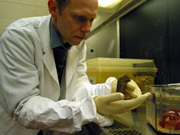
研究を行ったGleb Shumyatsky講師
動物の恐怖感をコントロールする遺伝子が,子供を守る親の行動を促進することがわかった。マウスを使った実験で,この遺伝子が正常な母親マウスは巣の外に散らばった子供たちを素早く連れ戻したが,遺伝子を不活性化したマウスは連れ戻すのが遅いなど,子供を保護する行動が抑制されていた。スタスミンやオンコプロテイン18などと呼ばれるこの遺伝子は,母親をいわゆる「ヘリコプター・ママ(子供を上空から監視する過干渉な母親)」にすると考えられるが,種の保存には必要なものだ。さらに今回の発見は,産後抑うつや境界性人格障害の理解にも役立つという。(吉田素子)
First, he discovered a gene(1) that controls innate(2) fear in animals. Now Rutgers geneticist(3) Gleb Shumyatsky has shown that the same gene promotes “helicopter mom(4)” behavior(5) in mice(6). The gene, known as stathmin(7) or oncoprotein 18(8), motivates(9) female animals to protect newborn(10) pups(11) and interact(12) cautiously(13) with unknown peers(14).
This “fear gene” is highly concentrated in the amygdala(15), a key region of the brain(16) that deals with fear and anxiety(17). Shumyatsky’s newest finding could enhance(18) our understanding of human anxiety, including postpartum depression(19) and borderline personality disorders(20).
Shumyatsky is an assistant professor(21) of genetics(22) in the School of Arts and Sciences at Rutgers, The State University of New Jersey.
Working with female mice genetically engineered(23) to have an inactive(24) stathmin gene, Shumyatsky demonstrated that these mutant(25) mice were slow to retrieve(26) pups placed outside the nest at corners of the cage. Females with normally active(27) stathmin, however, were quick to bring similarly(28) dispersed(29) pups back to the nest. In another experiment, knockout(30) mice chose to rebuild(31) nests in more vulnerable(32) open spaces instead of in safe corners, where normal mice typically(33) build nests.
The abnormal(34) behavior, concludes Shumyatsky, is based on the mouse’s lack of fear – in this case, fear for the safety of pups in her care. Retrieving wayward(35) pups is a behavior motivated by innate fear of attack by predators(36), a likely outcome for wild pups that stray from(37) the relative safety of a nest.
“The human analog(38) might be parents on a playground with their children when it starts to thunder,” said Shumyatsky.
(1) 遺伝子 (2) 先天的な (3) 遺伝学者 (4) ヘリコプター・ママ(過干渉または過保護な母親) (5) 行動
(6) マウス (7) スタスミン (8) オンコプロテイン18 (9) ~する気にさせる (10) 生まれたばかり (11) 動物の子
(12) 交流する (13) 注意して (14) 同等の者 (15) 扁桃体 (16) 脳 (17) 不安 (18) 増進する (19) 産後抑うつ
(20) 境界性人格障害 (21) 講師 (22) 遺伝学 (23) 遺伝子操作した (24) 不活性の (25) 変異の
(26) 取り戻す (27) 活性の (28) 同様に (29) 散り散りになった (30) ノックアウトされた(特定の遺伝子が
不活性化された) (31) 作り直す
(32) 攻撃を受けやすい (33) 一般的に (34) 異常な (35) 気まぐれな
(36) 捕食動物 (37) ~から外れる (38) 類似物