(C) Baylor College of Medicine
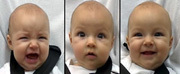
母親を喜ばせる赤ちゃんの笑顔が,脳の報酬系と呼ばれる部分を刺激することがわかった。報酬系は欲求が満たされた時に快いと感じる反応を引き起こし,薬物依存にも関与している。28人の母親に自分の子供と他人の子供の顔写真(笑顔,泣き顔,どちらでもない顔)を見せ,脳内の血流を測定したところ,自分の子供の顔,特に笑顔を見た時に報酬系の強い刺激が確認され,ナチュラル・ハイのような状態になっていることが明らかになった。研究が進めば,子供の発達に影響する母子の感情的なつながりを生理学的に解明する手掛かりになるかもしれない。(吉田素子)
The baby's smile that gladdens(1) a mother's heart also lights up(2) the reward centers(3) of her brain, said Baylor College of Medicine researchers(4) in a report that appears in the journal Pediatrics(5) today.
The finding could help scientists figure out(6) the special mother-infant(7) bond(8) and how it sometimes goes wrong(9), said Dr. Lane Strathearn, assistant professor(10) of pediatrics at BCM and Texas Children's Hospital and a research associate(11) in BCM's Human Neuroimaging(12) Laboratory(13).
Special relationship
"The relationship between mothers and infants(14) is critical for child development(15)," said Strathearn. "For whatever reason, in some cases, that relationship doesn't develop normally. Neglect(16) and abuse(17) can result, with devastating(18) effects on a child's development."
To study this relationship, Strathearn and his colleagues(19) asked 28 first-time mothers with infants aged 5 to 10 months to watch photos of their own babies and other infants while they were in a functional magnetic resonance imaging(20) scanner(21). The machine measures blood flow(22) in the brain. In the scans(23), areas of increased blood flow "light up(24)," giving researchers a clue(25) as to where brain activity(26) takes place.
In some of the photos, babies were smiling or happy. In others they were sad, and in some they had neutral(27) expressions.
They found that when the mothers saw their own infants' faces, key areas of the brain associated with(28) reward(29) lit up during the scans.
--Links to emotional(30) processing(31)
The areas stimulated by(32) the sight of their own babies were those associated with the neurotransmitter(33) dopamine(34). Specifically(35), the areas associated included the ventral tegmental area(36)/substantia nigra(37) regions, the striatum(38), and frontal lobe(39) regions involved in(40) emotion processing, cognition(41) and motor(42)/behavioral(43) outputs(44).
(1) ~を喜ばせる (2) ~を点火する(作動させる) (3) 報酬系 (4) 研究者 (5) 小児科学
(6) ~について解明する (7) 母子の (8) 結びつき,絆 (9) うまくいかない (10) 講師
(11) 研究員 (12) 神経画像検査 (13) 研究室 (14) 幼児 (15) 子供の発育 (16) ネグレクト(養育放棄)
(17) 虐待 (18) 壊滅的な (19) 同僚 (20) 機能的MRI(磁気共鳴画像法) (21) スキャナー (22) 血流
(23) スキャン(走査) (24) 明るくなる (25) 手掛かり (26) 脳の活動 (27) どちらともいえない
(28) ~と関連する (29) 報酬 (30) 情動の (31) 処理 (32) ~に刺激された (33) 神経伝達物質
(34) ドーパミン (35) 特に (36) 腹側被蓋域(中脳に位置する) (37) 黒質 (38) 線条体 (39) 前頭葉
(40) ~に関与する (41) 認知 (42) 運動の (43) 行動の (44) 結果