(C) Don Windsor, Smithsonian Tropical Research Institute
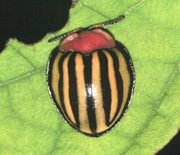
色鮮やかなカブト虫
植物に集まる昆虫の色が,薬効成分を含む植物の識別に役立つことが明らかになった。熱帯林に育つ植物のうち,マラリアなどの原因となる寄生虫や癌細胞に作用する成分を含んでいるものを使って,これらの植物にどんな色の昆虫が集まるか実験が行われた。その結果,薬効成分を含む植物は含まない植物に比べ,色鮮やかな毛虫やカブト虫を多くひきつけた。元来,昆虫の鮮やかな色は天敵を近寄らせない役割を果たすが,今回のように植物の成分と昆虫の色との関連がわかったことで,新薬の発見を数倍も効率化できることが期待される。(吉田素子)
Brightly colored(1) beetles(2) or butterfly larvae(3) nibbling on(4) a plant may signal(5) the presence of chemical compounds(6) active against(7) cancer(8) cell lines(9) and tropical(10) parasitic diseases(11), according to(12) researchers(13) at Smithsonian’s Tropical Research Institute(14) in Panama. Such clues(15) could speed drug discovery(16) and provide insight(17) into the ecological(18) relationships between tropical-forest(19) plants and the insects that feed on(20) them. The report is published in the Ecological(21) Society of America’s journal Frontiers(22) in Ecology(23) and the Environment.
“These findings are incredibly(24) exciting and important,” said Todd Capson, STRI research chemist(25), who directed the project. “The results of this study could have direct and positive impacts on the future of medical treatment(26) for many diseases around the world.”
For this research scientists used plants already known to have anti-cancer(27) compounds; those proven to be active against certain disease-carrying(28) parasites(29); and plants without such activity(30). The study showed that beetles and butterfly larvae with bright warning(31) coloration(32) were significantly(33) more common on plants that contained compounds active against certain diseases, such as breast cancer(34) and malaria(35). There was no significant(36) difference in the number of plain-colored(37) insects between plants with and without activity, according to the study by the Smithsonian’s Panama International Cooperative(38) Biodiversity(39) Group Program.
“We put two and two together,” said researcher(40) Julie Helson. “We knew that brightly colored insects advertise(41) to their predators(42) that they taste bad and that some get their toxins(43) from their host plants(44). But because other insects cheat(45) by mimicking(46) the toxic(47) ones, we weren’t sure if insect color was really going to work to identify plants containing toxins―it did!”
(1) 色鮮やかな (2) カブト虫 (3) 幼虫(larvaの複数形) (4) ~をかじっている (5) ~を知らしめている
(6) 化合物 (7) ~に対して活性をもつ (8) 癌 (9) 細胞株 (10) 熱帯性 (11) 寄生虫病 (12) ~によると
(13) 研究者 (14) 研究所 (15) 手掛かり (16) 創薬(新薬の発見) (17) 見識,洞察 (18) 生態学的な
(19) 熱帯林の (20) ~を餌にする (21) 生態学の (22) 最先端 (23) 生態学 (24) 途方もなく
(25) 研究化学者 (26) 治療法 (27) 抗腫瘍の (28) 病気を媒介する (29) 寄生虫 (30) 活性
(31) 警告する (32) 配色 (33) 顕著に (34) 乳癌 (35) マラリア (36) 重大な (37) 地味な色の
(38) 協力的な (39) 生物学的多様性 (40) 研究者 (41) 宣伝する(知らせる) (42) 捕食動物
(43) 毒素 (44) (昆虫が)とまっている植物 (45) 欺く (46) ~のまねをすること (47) 毒性のある